Doing a research project is often seen as a way for high school students to strengthen several parts of their academic profile at once. It shows the ability to commit to long-term work, genuine interest in a subject, and the capacity to handle college-level research while still in high school. Plus, it gives students the chance to dig into the “nitty-gritty” details of a topic they care about, which is something that colleges and scholarship committees often notice.
However, not all research opportunities are created equal. Here’s a quick overview of three types of high school research experiences, along with their pros, cons, and a few recommendations: Self-Directed Research, Guided/Coached Research, and Rigorous Online or In-Person Research Mentorships.
Tier 3: Self-Directed Research Project
This is usually the easiest—and least expensive—option for students, since it’s often free. But it’s also the least likely to impress admissions committees or significantly boost a college application. In a self-directed project, the student controls everything: selecting the topic, deciding on methods (literature review, small studies, etc.), setting timelines, and even determining whether to produce a final paper.
The upside? Because it’s entirely student-driven, this kind of project can highlight self-motivation, genuine interest, and the ability to balance research with a busy high school schedule. The downside? The risks are high. Is the topic truly research-worthy? Does the work meet college-level expectations? Who decides when it’s polished enough to be complete?
If the student hopes to publish, the stakes rise further: Who reviews the work for quality? How do they avoid predatory “pay-to-publish” outlets? And how will anyone verify the legitimacy of the research?
From an admissions officer perspective, while the independence of the project can be impressive, the pitfalls are significant. A project that lacks expert oversight or academic rigor may actually undercut the strong grades and test scores of an otherwise great academic profile. Self-publishing, in particular, is easy to do and rarely persuasive, as anyone can do it in the age of substack, blogs, etc. And since admissions officers rarely read the paper itself, the project may only appear briefly as an activity, on a résumé, or in a short essay response, none of which adds much weight compared to stronger Tier 2 or Tier 1 options.
Tier 2: Guided/Coached Research Project
This is the most common type of high school research project: independent work supported by an outside mentor. That mentor might be a parent, teacher, school advisor, local professor, or online coach. In some cases, students even work with a company that pairs them with a graduate student or professor, which will increase the cost, but still leaves the student largely driving the project.
With this support, students get help refining topics, aligning their work with college-level expectations, and running experiments. Many projects also feed into competitions like the National Science Fair or DECA, which are stronger when guided by a mentor who helps shape structure and substance.
Admissions officers usually view Tier 2 work more favorably than self-directed projects because it’s been vetted by an expert or tied to a recognized competition. Still, since they won’t read the research paper itself, the value comes from how the student presents it—through competition results, publication in a reputable, known outlet, or discussion in supplemental essays.
Tier 1: Rigorous Online or In-Person Research Mentorships
These are the most advanced research opportunities and can add a lot of value to a student’s academic journey outside the classroom. Many programs are paid and let students work directly with college PhD students or faculty in specialized subjects. Some allow students to choose their own topic, while others provide a list of research areas.
Tier 1 projects generally fall into two types. The first is pay-to-play programs, where students pay to be matched with faculty who guide them through the research process. They help with topic selection, creating a research plan, regular check-ins, and sometimes even publication in the program’s own journal or magazine. The second, more selective type only accepts students who show real academic curiosity and motivation. These projects tend to be more challenging and academically enriching.
Programs like CCIR show what this tier can look like. Small cohorts, usually no more than five students per course, work closely with faculty and get 1-on-1 mentorship. Projects are built for publication in undergraduate or industry journals and presentation at conferences, including CCIR’s own event where students can present alongside Nobel Laureates.
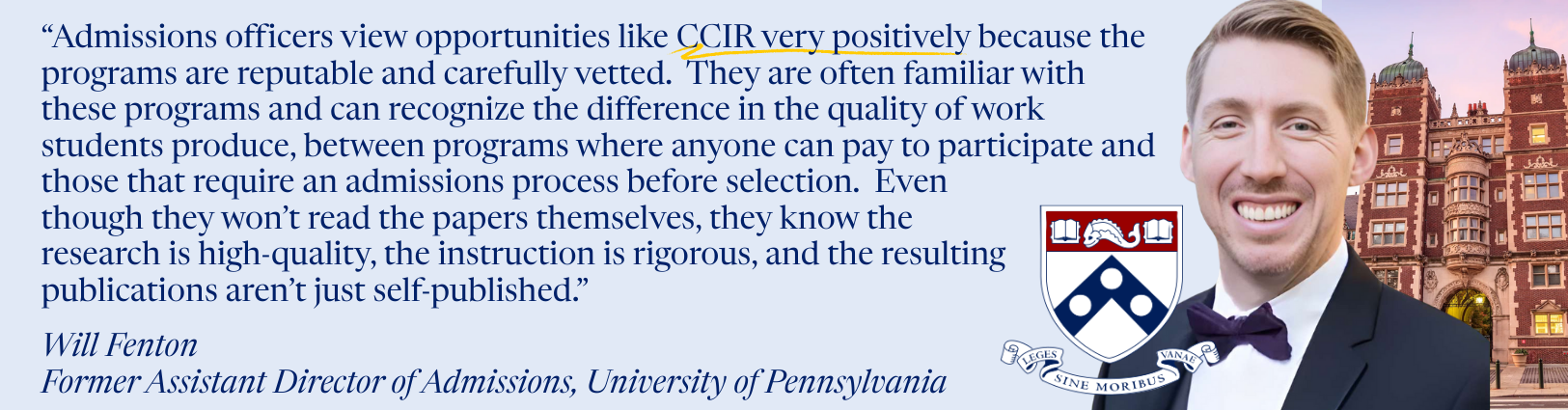
Admissions officers view opportunities like CCIR very positively because the programs are reputable and carefully vetted. They are often familiar with these programs and can recognize the difference in the quality of work students produce, between programs where anyone can pay to participate and those that require an admissions process before selection. Even though they won’t read the papers themselves, they know the research is high-quality, the instruction is rigorous, and the resulting publications aren’t just self-published by the company.
While all of these programmes have their benefits, for students that really want to push past their academic limits, make new connections with amazing faculty and explore hitherto unknown topics, the Tier 1 Rigorous Research Mentorship Project is the clear winner, and CCIR is an excellent choice in this category.
Summary Comparison of High School Research Options
| TIER | DESCRIPTION | STRENGTHS | LIMITATIONS |
| Tier 3: Self-Directed Research | Fully student-driven projects with no required mentor | Shows self-motivation, allows exploration of personal interests, flexible with schedule | High risk of choosing a weak topic, limited guidance, may not meet college-level expectations, publishing is challenging |
| Tier 2: Guided/Coached Research | Projects with guidance from a teacher, parent, mentor, or advisor | Provides direction and structure, helps meet college-level standards, easier to complete successfully | May involve a cost, success depends on quality of mentorship, less independent than Tier 3 |
| Tier 1: Rigorous Mentorships | Selective programs working closely with faculty or PhD students, often paid | Offers in-depth learning, strong academic credentials, networking opportunities, potential for publication and conference presentations, most likely to improve college applications | Can be costly, competitive admission, highly time-intensive |