What can high school students achieve when they have the opportunity to pursue original academic research? For Petra Hedesiu, a graduate of the
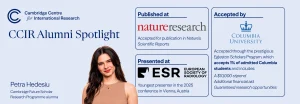
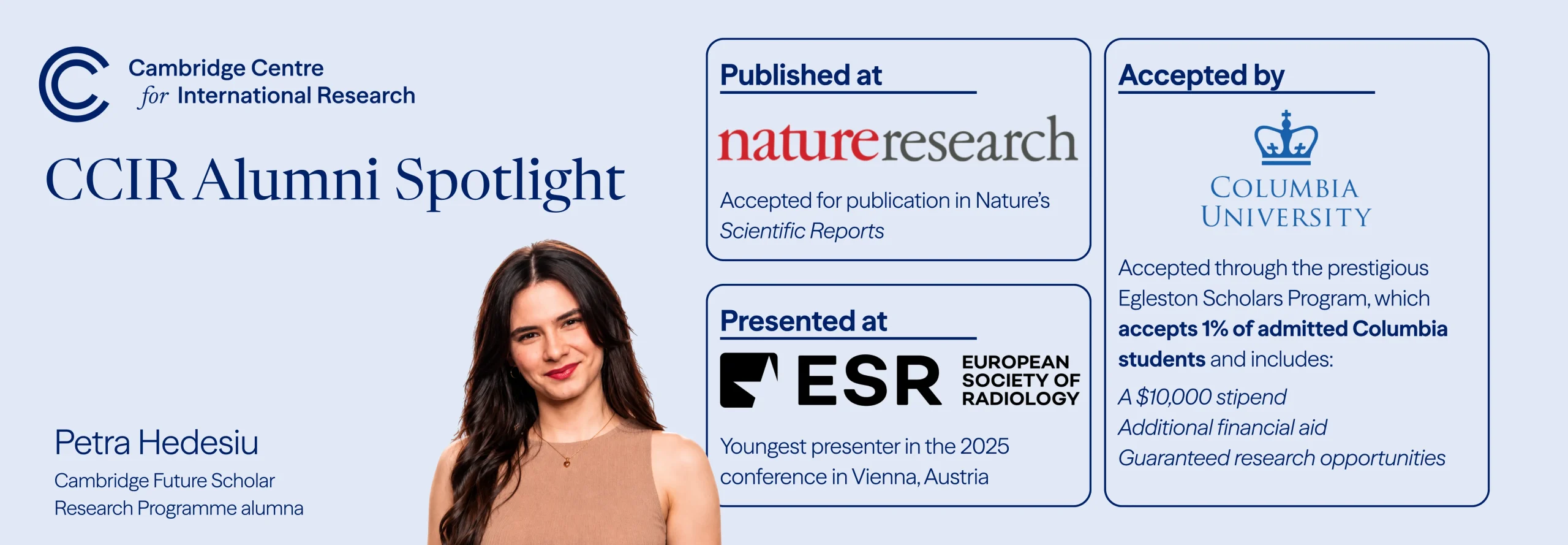
CCIR Cambridge Future Scholar Research Programme, the answer includes developing a machine learning model for medical imaging, presenting research at an international conference, and continuing her academic journey at Columbia University.
Petra’s research paper has been accepted for publication in Scientific Reports, a scientific journal published by Springer Nature’s Nature Portfolio. Her achievements demonstrate how early engagement with independent research can help students explore complex academic questions and develop their interests beyond the traditional classroom.
Read on to discover how Petra’s research journey developed through CCIR and how her experience reflects the value of sustained academic curiosity, research mentorship, and independent inquiry.
Exploring the Intersection of Artificial Intelligence and Medical Imaging
Petra’s research focused on the intersection of artificial intelligence (AI), machine learning, and medical imaging. Under the mentorship of Dr Kutsev Ozyoruk (Harvard/Emory), she investigated the challenge of identifying carotid artery encasement, a complication associated with cancer that can be difficult to assess accurately.
To address this challenge, Petra developed a novel machine learning model designed to detect carotid artery encasement automatically in computed tomography (CT) scans. Her work explored how computational approaches could support the analysis of medical images and contribute to research into complex diagnostic problems.
The project required Petra to engage with a specialised research question, develop a technical approach, and communicate her findings through a formal academic study.
Her experience illustrates how high school research programmes can give students the opportunity to investigate advanced topics that connect multiple disciplines, from computer science and engineering to medicine and healthcare.
Students interested in exploring similar interdisciplinary questions can learn more about the
CCIR Cambridge Future Scholar Research Programme, which supports students in developing independent research projects under the guidance of experienced academic mentors.
From Independent Research to Scientific Publication
One of the significant milestones in Petra’s academic journey is the acceptance of her research paper for publication in Scientific Reports.
Published by Nature Portfolio,
Scientific Reports is an open-access journal that features original research across the natural sciences, medicine, engineering, and other fields. Publication in a scientific journal provides researchers with an opportunity to communicate their work to the wider academic community.
For Petra, this milestone represents the progression of an independent research project into a formal scholarly contribution.
The journey from an initial research question to a completed paper involves more than developing an interesting idea. Students must engage with existing literature, establish an appropriate methodology, analyse their work, and communicate their findings clearly. Research mentorship can help students navigate these stages while developing the skills needed for more advanced academic work.
Petra’s achievement is also a reminder that meaningful research can begin before university. With appropriate guidance and a genuine commitment to investigating a question, high school students can begin developing the foundations of academic inquiry.
Inspired by Petra’s achievement of having her research accepted for publication in Scientific Reports? Discover how you can explore your own academic interests, develop an original research paper, and work with experienced professor mentors through CCIR Academy’s research programmes. Start exploring your opportunities through our
research enquiry form.
Presenting Research at the European Congress of Radiology
Before her paper was accepted for publication, Petra submitted and presented her research at the European Congress of Radiology (ECR) in Vienna, Austria, in February 2025.
According to her
official Columbia Engineering student profile, Petra was the youngest presenter at the professional-level conference.
Presenting research at an international academic conference is an important opportunity to communicate findings to specialists, explain the significance of a research question, and participate in a wider professional discussion.
For students, this experience can also help develop essential academic skills, including scientific communication, critical thinking, and the ability to explain complex ideas to an informed audience.
Petra’s presentation demonstrates how independent research can extend beyond writing a paper. It can also create opportunities to share findings with researchers and engage with the broader academic community.
To learn more about the conference, visit the
European Society of Radiology.
From CCIR Research to Columbia University’s Egleston Scholars Program
Petra’s academic journey continued with her admission to Columbia University, where she was selected for Columbia Engineering’s Egleston Scholars Program.
The programme recognises students for their academic achievements, research potential, and leadership. Petra’s selection represents another important milestone following her experience conducting independent research through CCIR.
Reflecting on her experience, Petra shared:
“Thank you for all your support during the program. The research experience CCIR gave me helped me earn a likely letter to Columbia University, through the Egleston Scholars Program, which accepts about 1% of admitted Columbia students.”
Her experience highlights the connection between sustained academic engagement and the development of a student’s academic profile. By pursuing a specialised research question, Petra gained experience in an area that aligned with her interests in machine learning and medical imaging.
However, every student’s university application journey is different. Research experience does not guarantee admission to a particular university or programme. Rather, it can provide students with an opportunity to demonstrate intellectual curiosity, initiative, and the ability to undertake independent academic work.
Petra’s story offers a valuable example of how pursuing a genuine academic interest can become part of a student’s broader educational development.
Read more about Petra’s achievements in her
official Columbia Engineering profile.
What Petra’s Journey Shows About High School Research
1. Start with a Question That Genuinely Interests You
Strong research begins with curiosity. Petra explored a challenging problem involving machine learning and medical imaging, combining technical methods with a question relevant to medical research.
Students do not need to begin with a fully developed project. They can start by identifying a subject they want to understand more deeply and gradually refining that interest into a focused research question.
2. Learn to Work Through Complex Academic Problems
Independent research involves more than finding information. Students must evaluate existing evidence, understand research methods, consider limitations, and develop a reasoned approach to their questions.
Working through these challenges helps students develop analytical thinking, academic writing, and problem-solving skills that can support their future studies.
3. Seek Guidance While Taking Ownership of Your Work
Mentorship can provide direction when students encounter unfamiliar concepts or methodological challenges. At the same time, meaningful independent research requires students to actively engage with the process, make decisions, and take responsibility for developing their projects.
CCIR’s research programmes are designed to help students explore academic interests and develop original research with support from experienced faculty mentors.
Students can explore the
1-on-1 Research Mentorship Programme to learn about a personalised research experience built around an individual student’s interests and project goals.
4. Think Beyond the Classroom
Research can help students explore subjects in greater depth than a conventional school curriculum may allow. It can also introduce them to the expectations of academic writing, scholarly communication, and presenting ideas to others.
Petra’s experience, from developing a machine learning model to presenting at an international conference, demonstrates how a research project can evolve through different stages of academic work.
These experiences can help students better understand their interests and prepare for the intellectual demands of university-level study.
Your Research Journey Could Start with CCIR
Petra Hedesiu’s journey from the
CCIR Cambridge Future Scholar Research Programme to scientific publication and Columbia University demonstrates what can happen when students have the opportunity to pursue their academic interests through independent research.
Her experience brings together several important milestones: investigating a specialised research problem, developing a machine learning model for medical imaging, presenting findings at the European Congress of Radiology, and earning admission to Columbia University’s Egleston Scholars Program.
At CCIR, students receive professor-level mentorship and ongoing research support as they develop their own projects. Students work towards producing an original research paper, with opportunities to pursue publication or conference presentation where appropriate. Outcomes depend on the individual project, its quality, and the requirements of the relevant academic venue.
For students interested in exploring subjects beyond the school curriculum, research mentorship can provide a structured way to investigate new ideas, strengthen academic skills, and begin building a foundation for future study.
Your own research journey could start here.
Discover the
CCIR Cambridge Future Scholar Research Programme and explore opportunities to develop an independent research project with experienced academic mentors.
Ready to take the next step?
Download the
CCIR Research Programme Prospectus to explore research areas, learn about programme formats and mentorship opportunities, and find out how to apply.