Research programmes allow high school students to explore subjects beyond the classroom while developing real-world research skills. However, the cost can make some programmes difficult to access.
While free research programmes for high school students exist, “free” doesn’t mean the same thing from one programme to the next. Some cover tuition only, and leave travel and housing to the family. Others are fully funded, right down to a stipend.
This guide explains what free research programmes usually include, where to find them, and how to compare opportunities based on your interests, eligibility, location and budget.
What Does a Free Research Programme Cover?
Before comparing programmes, it’s worth unpacking what “free” usually means, because the fine print varies more than most roundups let on. Here’s what to check for on any programme’s own admissions page.
- Tuition or programme fees: Tuition-free research programmes for high school students don’t charge for mentorship or coursework, and lab access is included as well.
- Housing and accommodation: Residential programmes sometimes cover housing as part of the package, and sometimes bill it separately. A programme can be fully tuition-free and still leave you paying several thousand dollars for a dorm room over the summer.
- Meals. Usually bundled with housing at residential programmes. Remote programmes obviously don’t need to address this at all.
- Research materials. The host institution or mentor typically provides lab supplies, software licences, and access to academic databases, since students wouldn’t otherwise have access to them.
- Travel costs. Getting to and from a residential programme, including flights for international students, is usually the family’s responsibility, even when everything else is free.
- Application fees. Some selective programmes charge a modest, non-refundable fee, often somewhere between $50 and $100, but many offer fee waivers for students who can’t afford it.
- Other possible expenses. Health insurance during a residential programme, submission or printing costs if you’re pursuing publication afterwards.
What to Compare When Choosing a Free Research Programme
Once you’ve confirmed what a programme charges for, the next step is figuring out whether it fits what you’re looking for. A few factors may matter more based on your situation.
Eligibility
Grade level and citizenship rules are the fastest way to get ruled out. Many free research opportunities for high school students, including some of the most well-known ones, have limitations.
Fewer programmes accept high school students from anywhere in the world. These international options are limited, and many favour applicants with a strong academic background in the subject.
Research Fields
Free programmes lean heavily toward STEM, and within STEM, mathematics and computer science are especially well represented, partly because those subjects can be studied and mentored entirely online without lab access.
Online vs. In-Person
Online programmes tend to be more accessible for students outside the host institution’s country, and they remove travel costs from the equation.
In-person, residential programmes offer hands-on lab work and a more immersive experience, but usually come with tighter citizenship and location restrictions.
Summer vs. Year-Round
Free summer research programs for high school students, like residential lab placements, run for a few intensive weeks.
Year-round or year-long programmes meet on a lighter weekly schedule but stretch over many months, which suits a slower-paced, more sustained research project.
Duration
This ranges widely, from a six-week summer programme to a full calendar year of weekly mentor meetings. Longer programmes generally go deeper into a single project; shorter ones move faster but cover less ground.
How Does a Mentorship Work?
Mentorship structure is one of the biggest practical differences between programmes, and it’s easy to overlook.
Some programmes place you one-on-one with a single mentor for the full duration. Others work in small groups of two to five students, with a mentor and a teaching assistant supporting the group together.
Who that mentor actually is also varies. Faculty members provide a different kind of guidance than postdoctoral researchers or graduate students, who are common in university-run programmes, since they often lead day-to-day research supervision.
What Do You Need to Apply for a Research Programme?
Application requirements differ by programme, but a few components show up repeatedly:
- Academic transcript: Most programmes want to see your grades in relevant subjects.
- Letters of recommendation: Usually one or two, ideally from a teacher who can speak to your ability in the subject area.
- A personal statement or short essays: These explain your interest in the subject and, sometimes, your specific research goals.
- A problem set or writing sample: Common for mathematics-focused programmes, where solving a set of problems demonstrates readiness better than grades alone.
- Standardised test scores: Some highly selective residential programmes require SAT or ACT scores. They may also ask for PSAT scores to assess your academic preparation.
- A school nomination: A handful of programmes require your school to nominate you before you can apply at all, rather than letting you apply directly.
None of these requirements are unique to free programmes.
What You’ll Do and Gain From a Research Programme
The day-to-day experience depends heavily on the programme format.
- In a residential lab placement, you might spend most of the day in an active lab, running experiments or analysing data alongside a mentor and other students.
- In a remote, year-long mentorship, the rhythm is closer to a weekly meeting with independent work in between, gradually building toward a finished project.
- In open, collaborative formats, you’re contributing to a shared problem in an online forum alongside a broader group.
What you produce at the end varies just as much. Some programmes ask students to write a formal research paper, while others culminate in a poster presentation or symposium.
Some may provide a certificate of participation without requiring a substantial research output. Some programmes also help students prepare work for journal or conference submission. However, publication is never guaranteed.
It’s worth being realistic about what a research programme can offer, though. A good programme can help you develop research skills and leave you with a concrete project to discuss in the future.
However, it won’t guarantee admission to a particular university, and any programme making that promise should be treated with caution.
Examples of Free Research Programmes for High School Students
Rather than listing every free programme that exists, it’s more useful to look closely at a handful, since the details differ in ways that matter.
Research Science Institute (RSI)
A six-week, fully funded residential programme at MIT, sponsored by the Center for Excellence in Education. Tuition and housing are covered, and so are meals. The only cost is a $75 application fee, with waivers available.
RSI is open only to current high school juniors who will turn 16 by 1 July of the programme year, and it’s extremely selective. Around 100 students are admitted from roughly 3,000 applicants each year, drawn from both the US and abroad.
MIT PRIMES-USA
A free online research program for high school juniors and sophomores, run year-round and fully remote. You meet weekly online with a mentor to work through an original mathematics research problem.
It’s open only to students in the United States outside the Greater Boston area. Applications typically open in autumn, with a 1 December deadline.
Simons Summer Research Program
A six-to-seven-week, tuition-free residential research programme at Stony Brook University for high school juniors who are US citizens or permanent residents. You’re matched with a faculty mentor in a working lab and present a poster at a closing symposium.
Housing has a separate cost, roughly $2,400 for the summer in recent years, which is why this one is tuition-free rather than fully funded. A school nomination is required before you can apply.
CrowdMath
An ongoing, free, fully remote mathematics research collaboration run jointly by MIT and the Art of Problem Solving. It suits students with a strong background in proof-based mathematics rather than complete beginners.
Unlike the programmes above, it’s open to high school and college students worldwide, with no citizenship restrictions, making it one of the few genuinely international free options in this space.
Comparing Free Research Programmes for High School Students
Here’s how those four compare at a glance:
| Programme | Format | Cost | Who it’s for |
| RSI | Residential, 6 weeks | Fully funded, plus a $75 application fee | US and international juniors, extremely selective |
| MIT PRIMES-USA | Remote, year-long | Free | US students outside Greater Boston, maths-focused |
| Simons Summer Research | Residential, 6 to 7 weeks | Tuition-free, housing extra | US citizens or permanent residents, juniors only |
| CrowdMath | Remote, ongoing | Free | Open worldwide, advanced maths background helps |
This is a small, verified sample rather than a ranked list of “the best” options. Dozens of other free research programmes exist at the university and state level, as well as through nonprofit organisations.
Your own school counsellor or a nearby university’s outreach office is often a good source for options specific to your region.
Other Ways to Gain Research Experience
Free research programmes can be a great way to gain hands-on research experience, but they are not available to everyone. Some restrict applications to US citizens or permanent residents, while others accept students only in certain year groups. Competition can also be intense because funded programmes have a limited number of places.
If you do not meet the eligibility requirements, other programmes can provide another route into research. They’re also great if you want a specific type of mentorship or a research format that free programmes do not offer.
CCIR Academy offers the Cambridge Future Scholar Research Programme and 1-on-1 Research Mentorship. Students are taught by professors and current faculty members from Cambridge, Oxford, Ivy League universities, and other leading US and UK institutions. The research areas span STEM, the humanities, and the social sciences, as well as a wide range of interdisciplinary fields, with opportunities connected to labs at MIT and in Silicon Valley.
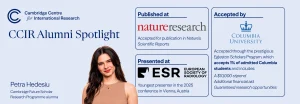
CCIR students have conducted university-level research during these programmes. Some have presented or published their work through IEEE conferences, MIT URTC, and The Royal Astronomical Society through Oxford University Press. You can find examples in CCIR’s student spotlights. CCIR has a rigorous admissions process. Students submit an application, selected applicants are invited to interview, and professors make the final admissions decisions. CCIR also offers merit-based scholarships, with no separate application required. Students who need financial support are encouraged to apply for financial aid. Each year, CCIR admits talented students who may otherwise be unable to afford the programme. For students who are excluded from some free programmes because of US citizenship requirements, however, CCIR can provide an alternative without those same restrictions.
Before applying, check the CCIR FAQs for the current eligibility requirements and programme format.
Frequently Asked Questions
Are there completely free research programmes for high school students?
Yes. Programmes like MIT PRIMES-USA and CrowdMath charge nothing, while fully funded residential programmes like RSI cover tuition, housing, and meals, plus a small application fee. CCIR also offers merit-based scholarships and financial aid for students. In addition, CCIR research programmes are online, so students do not need to arrange housing or travel to campus.
What costs are usually covered by a free research programme?
At a minimum, tuition or the mentorship itself. Fully funded residential programmes also cover housing and meals. Travel to campus and personal spending money are often left to the family, even when the programme itself is free.
Are free research programmes competitive?
Yes. Many free research programmes are highly competitive. For example, RSI admits around 100 students each year from thousands of applicants. CCIR is similarly selective, with fewer than 20% of applicants admitted to conduct university-level research. Professors from Cambridge, Oxford, Ivy League universities, and other leading US and UK institutions guide students through their research.
Can international students apply for free research programmes?
Some can, but many well-known free programmes are limited to US citizens or permanent residents. A smaller number, such as CrowdMath, are open worldwide. CCIR offers merit-based scholarships and full financial aid each year to talented students who require financial support, including international students seeking access to research opportunities.
Where can students find free research opportunities?
University STEM outreach offices and school counsellors are good starting points, and so are subject-specific organisations. It’s also worth checking whether your own state or a nearby university runs a lesser-known regional programme, since these don’t always appear on national lists.
Ready to explore your research opportunities?
Discover how you can pursue university-level research with expert mentorship, even if you don’t qualify for every fully funded programme.
Download the CCIR Research Programme Prospectus to explore our 170+ research areas, learn about our Cambridge Future Scholar and 1-on-1 Research Mentorship programmes, meet professor mentors from leading universities, and discover merit scholarships, financial aid, student outcomes, and the application process.