Rohan Kalluraya, from the DLRC Foundation in India, conducted research on reducing the cost of COVID-19 biomedical waste collection. His paper, “Minimizing Costs of Covid-19 Biomedical Waste Collection Using Mixed Integer Linear Programming Approach,” explores how mathematical optimisation can improve medical waste collection routes.
Rohan’s Research on Biomedical Waste Collection
Rohan used a mathematical method called Mixed Integer Linear Programming (MILP) to study the Multiple Traveling Salesman Problem (MTSP).
The Traveling Salesman Problem focuses on finding the most efficient route between several cities. The goal is to minimise travel costs while visiting each city once. Similarly, the Multiple Traveling Salesman Problem considers several salespeople who must visit a set of cities efficiently.
Rohan applied this concept to a real-world challenge: finding optimal routes for COVID-19 biomedical waste collectors. His approach aimed to ensure that each collection centre received a visit while reducing transport costs.
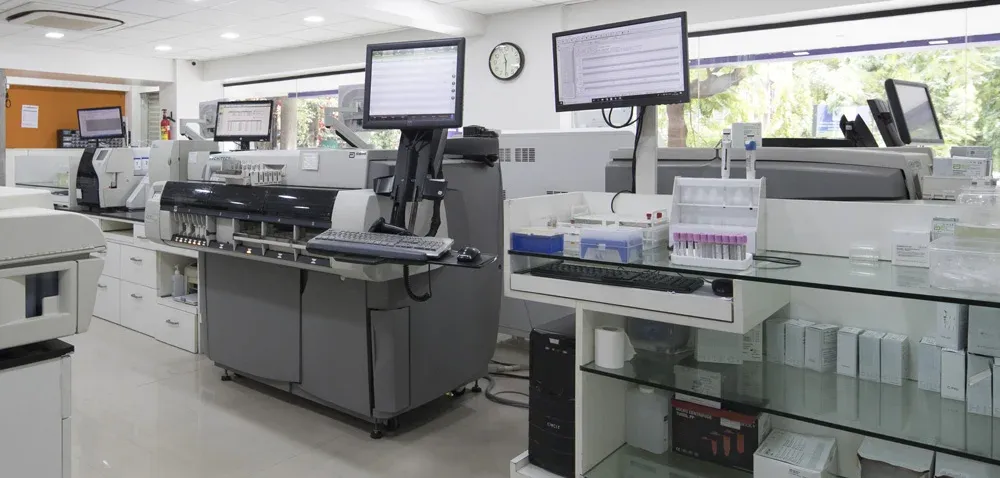
(AG Diagnostics lab in Pune, India)
Applying the Research at AG Diagnostics
AG Diagnostics, a NABL-accredited reference laboratory in Pune, India, approached Rohan to implement his project.
Using the OpenStreetMapX package in the Julia programming language, Rohan calculated travel distances and times between the laboratory’s 34 centres. He then used this data in a mixed integer linear program.
The programme considered driver time limits and aimed to minimise transport costs. As a result, it generated four routes. Each route covered the required centres and returned to the main centre at the end of the day.
Reducing Daily Transport Costs by 35%
Rohan’s approach delivered a measurable improvement for AG Diagnostics. The new routes reduced daily transport costs from ₹1,400 to ₹893.
This represents a 35% reduction in daily costs. The result demonstrates how mathematical optimisation can help organisations improve logistics and manage operating expenses.
Beyond its practical application, Rohan’s research paper was also being considered for publication, according to the original article.
Read Rohan’s Research Paper
You can read the full paper, “Minimizing Costs of Covid-19 Biomedical Waste Collection Using Mixed Integer Linear Programming Approach,” by following the link below.
Download Rohan’s Research Paper
Explore Your Research Interests
Are you interested in mathematics, computer science, or operations research? An original research project can help you apply analytical methods to real-world challenges with guidance from experienced professor mentors.
Download the CCIR Research Programme Prospectus to explore our 170+ research areas, learn about the Cambridge Future Scholar and 1-on-1 Research Mentorship programmes, and discover professor mentors, student outcomes, scholarships, and the application process.